Monday, 26 November 2012

Love is everywhere


In my book, Finding Artemisia, Artemisia struggles with alienation and isolation in her daily struggle with eating and body image. She writes about it in her Oracle
Here's what she says is the way out: LOVE
  
LOVE
Love on Earth can often hide, And we can be fooled by its disguise. 
No definitions of it we can command;
It is not supplied on-demand.
It gives freely without conditions;
It sings sweetly of soft renditions.
It blossoms in flowers and exudes rich perfume.
It sings from a bird’s throat in the morning
And at noon.
It shines in the night sky of unfathomable depth.
And it lives in the eyes of all who have wept.
To taste it, you just need to be awake;
It’s in the smile of your mate.
It’s in a lover’s perfume,
And it’s in the solitude of your room.
Do not despair when you think you can’t find it,
For ‘tis EVERYWHERE.

--From The Oracle


Follow me on Facebook and Twitter. Purchase Finding Artemisia here.

Friday, 16 November 2012

An Ode to Marilyn


In my book Finding Artemisia, Artemisia is a 14 year old girl with anorexia. She calls her collection of thoughts, drawings and poetry The Oracle. One of the most touching poems in The Oracle is her ODE TO MARILYN


If I were Marilyn Monroe, the famous beauty queen,
And you, the wise professor, with thoughts and words to preen,
I’d prance about and whimper and wait impatiently
For your wise and golden knowledge to graciously encompass me.
And when you finally would appear, with thoughts and words in hand,
I’d toss my hair and bare my breasts and bleat of the love you’d fanned.
You’d smile perhaps a little, but seriousness soon would grow,
As you carefully consider how I fit with what you know.
“The pleasures of the flesh I have chosen to ignore,
I seek the greater things in life, the sea, not just the shore.”
And I would smile as teardrops fell on beauty spots that cried,
“I’ll know that all too soon, my friend, for I’m about to die.
You’ve failed to see my beauty; you’ve been blinded by your eye.
Your mind is crammed with things you know,
And your heart’s afraid to fly.”
So now the world does mourn me, and all the ghosts do sigh.
But you once had your chance, and you sooner had me die.

Finding Artemisia: a journey into ancient women's business. p36 www.findingartemisia.com


Friday, 9 November 2012

After the election.. the anxiety continues

The American elections took up a lot of air space in Australia as well other countries concerned about  the effects on Wall St and the international monetary systems. Anxiety about money seems to be the order of the day. And anxiety belongs to situations that are out of one's control. (I know, I see a lot of anxious people. Im a psychologist.) Sometimes such anxious people are known as the worried well, because they're not really unwell, they just don't feel safe about the future or even the present.  Even after the election they still have the jitters as does Wall St. And why wouldn't they? Their money, their future is the hands of people who are proving themselves to be incompetent, amoral and driven by self interest. So what about taking our power back. One country has shed its national debt. Iceland. But maybe America/ Europe/Australia are more complicated. So what can we do as individuals?
1 stop repeating the same mistakes
2 stop investing in systems that rob the poor to pay the rich
3 stop expecting governments to bail out failing systems
4 start acting locally in our community
5 rely less on money, begin to trade, exchange and recycle
6 build community networks that are supportive and sustainable
7 get creative about ways to obtain income

BUT MOST IMPORTANTLY STOP EXPECTING GOVERNMENTS TO SAVE US. THEY CAN'T. THEY KNOW IT. AND IT'S ABOUT TIME WE DID TOO


Sunday, 4 November 2012

After the storm

Storms are a natural part of the growling, tempestuous earth on which we live. Perhaps global warming has contributed to their intensity, but many ancient peoples have recorded big winds and high waters. The Australian Aboriginal people lived through over 40,000 years of climactic changes and in their wisdom often moved out of harm's way, at the first signs of trouble to come. Their adjustment to Mother Nature's moods was not hampered by the sort of infra structures that industrial nations have since built. Aboriginal people had no sky scrapers, undergrounds or cities balancing on reclaimed lands.  They lived with the Earth, feeling her movement, reading her signs. When the big flood hit Brisbane not long ago, the waters reached right through the centre  of Australia as they had done before, many times. And so as we watch tsunamis sweep into Japan destabilising nuclear reactors, and cities like New York being washed by the sea, we realise how much faith man has in his own creations and yet how little connection to the seasons of the earth.  The earth is ancient and modern man, but a pup. Perhaps the engineers need to have a longer conversation with the people who have walked upon the Earth for eons.  Perhaps we need to remind them.


Wednesday, 24 October 2012

The power of Aunties

I have three sisters and only one of them has no children. And yet her role with all the children in our family is vital to their sense of belonging. She is Aunty to 7 children who love and adore her. Being an Aunty is a powerful thing. There is connection but space, (unless the Aunty is the full time carer). Nieces and nephews look to Aunties for company, fun and guidance, and sometimes a safe place away from a troubled home.
In ancient women's business Aunties rule. They are the women who lead, nurture and protect children and the earth. They are respected by their communities and valued for their great contributions.
Did you have an Aunty when you were a child? Can you remember her smell, what she looked like, what she taught you? Did you want to grow up to be like her. In my book Finding Artemisia both Artemisia and Diana, her psychologist,  had strong connections to their Aunts. Would you like to share your story?

Tuesday, 16 October 2012

Mothers and daughters

Our mothers are our first mirrors, they have the eyes we seek, the love we need, the touch we crave. But what if they are aloof, distracted, angry, grieving, anxious, unsupported AND in pain? It's hard not to take it personally. But that's what we do in the modern world.  Take it all on. As daughters, we are very susceptible to our mothers,  AND there's a big chance we'll end up mothering, just like them. Or even avoid motherhood altogether.
The modern mother-daughter relationship is intense, often too intense for both parties: boundaries are blurred, co-dependence abounds, and roles reverse chaotically. Pity the daughter who has to search herself to find the way to mother her own daughter.
So what would make a mother a positive mirror? What would she need to be able to connect, love, enjoy, play, as well as nurture her darling daughter?
The answer is  easily found in ancient women's business, where the child is loved and nurtured by all those around her. In effect, she has a wide selection of mirrors, rather than the singular. Imagine the freedom in that for both mother and daughter. Mother would not be isolated, anxious, or over burdened, but rather she would have the support of a strong base and a sense of belonging to the community of women, who understand what women need. And the daughter therefore would be less dependent on her, moving freely from one set of arms to another.
Too idealistic you say. I think not. We have ancient women's business in our genes: we love to get together, laugh and share. We just need to make an effort to create community wherever we are so that our daughters will feel safe and protected from the intensity of the modern mother/daughter realtionship and then their daughters and their daughters......
Want to give it ago. Tell us what you would do first.

Thursday, 11 October 2012


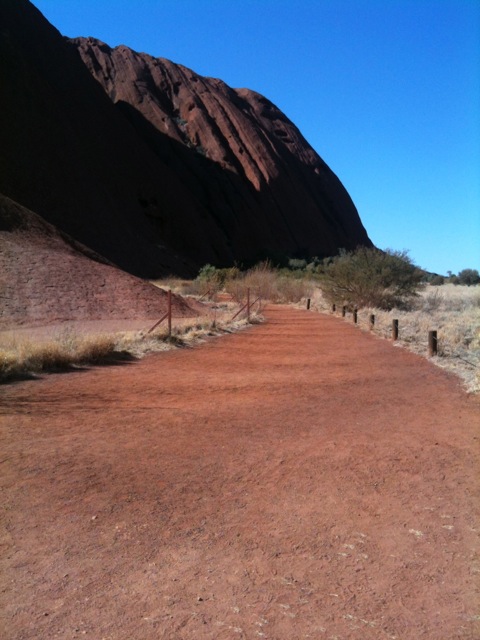
This is the path Diana took around Uluru, the world's largest monolith and where she contemplates the issues plaguing women today: women's self esteem, body image and worth. Here she experiences the importance of the role of the mother in a girl's development. Although a mother herself, psychologist Dr Diana Verdi rarely has the time to support the mothers of the girls she treats for anorexia. But after her time with Aboriginal women, she realises  she had been treating the girls in the "vacuum" of her therapy room, without the support of the mothers, aunties and the community.
She has in fact replaced Artemisia's mother on one level, and so when the girl disappears she is devastated. It is only when she is immersed in the ancient women's business of the Australian Aboriginal women,  that she realises that psychology and therapy alone are not enough to heal the girl.